
TL;DR: What you need to know
• Your options: a drop-in cat sitter, an overnight sitter, a friend, a cat boarding facility, or taking your cat along.
• A healthy adult cat can manage about 24 hours alone. Past that, someone needs to see your cat daily.
• Leaving a cat alone for a week is not safe, even with an automatic feeder.
• For a weekend, a drop-in pet sitter for cats usually wins. For four days or more, we’d choose a cats-only boarding facility or an overnight sitter.
• In Illinois, cat boarding businesses must hold a state license. Ask to see it.
What to do with your cat when traveling: which options do you have?
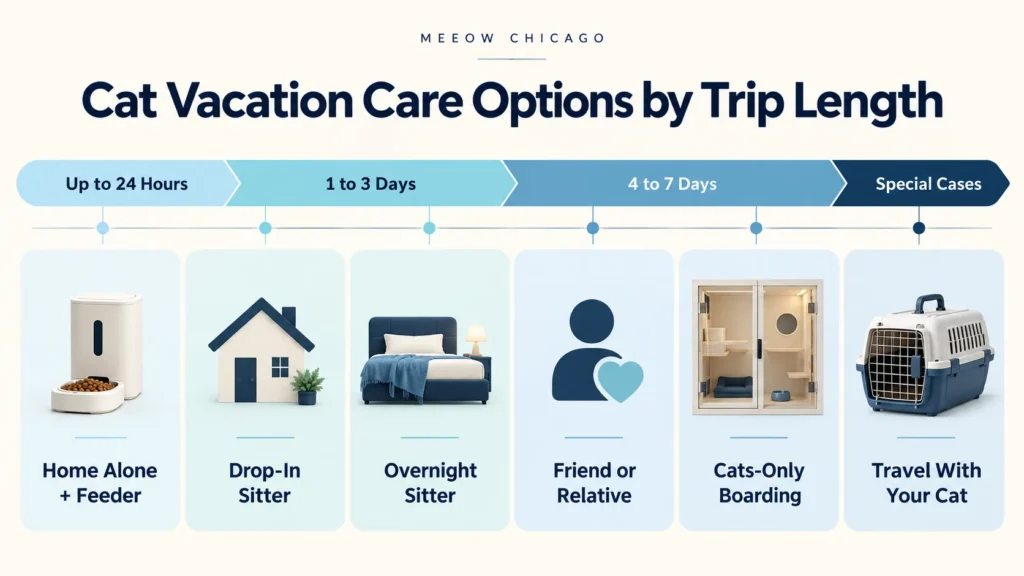
Your cat vacation care options fall into six groups, each trading cost against human contact. Vacation pet care for cats is never one-size-fits-all, and neither is cat care while on vacation, so read the table by trip length first.
| Option | How it works | Best for | Main risk |
|---|---|---|---|
| Home alone with an automatic feeder | No visits | Up to 24 hours | Nobody notices illness |
| Drop-in cat sitter | 1 or 2 visits a day | 1 to 5 days, shy cats | About 23 hours alone daily |
| Overnight or live-in sitter | Sitter sleeps over | Long trips, senior cats | Highest nightly cost |
| Friend or relative | Unpaid visits | Short trips | Missed visits, no backup |
| Cat boarding facility (cattery or cat hotel) | Licensed, staffed stay | 4+ days, oral meds, multi-cat homes | A new room to adjust to |
| Travel with your cat | Rides along in a cat carrier | Moves, confident travelers | Transit stress |
Notice the pattern. At-home options protect routine but leave supervision gaps. Away-from-home options close the gaps but ask your cat to adjust. Pick the trade your cat handles better.
How long can you leave a cat alone?
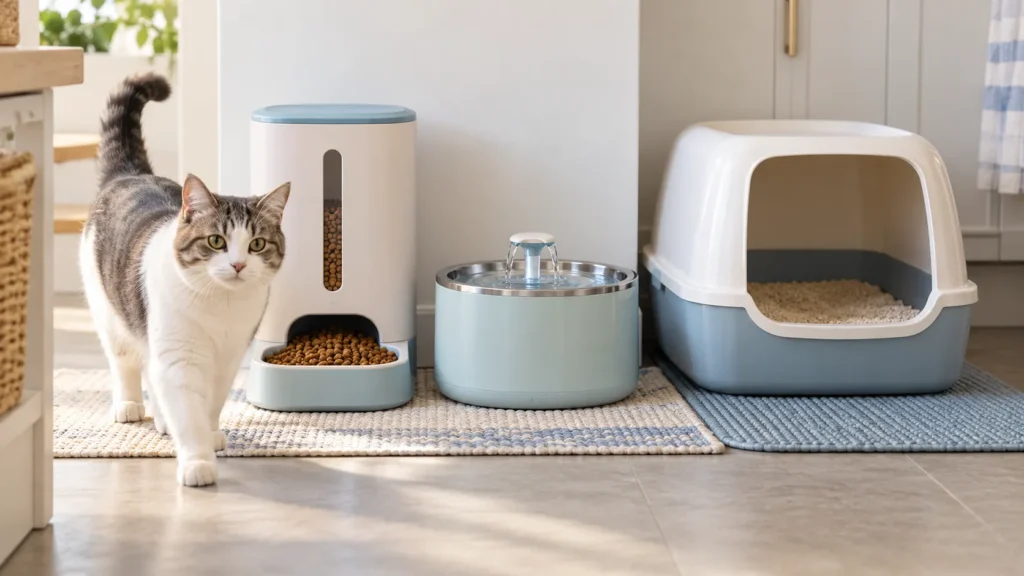
A healthy adult cat can usually be left alone for about 24 hours with fresh water, food and a clean litter box. Beyond that, plan on daily human contact, and more for kittens, seniors and cats with medical conditions.
The real risk is appetite, not loneliness. The University of Illinois College of Veterinary Medicine warns that a cat going without food for a few days in a row risks hepatic lipidosis (fatty liver disease), which can be fatal.
The Cornell Feline Health Center adds that the condition is almost always preceded by a cat refusing food. A stressed cat in an empty house may quietly stop eating, and no camera reliably shows you that.
An automatic feeder works like a vending machine: it dispenses food on schedule but has no idea whether anyone is buying. A person notices the full bowl on day three.
Is leaving a cat alone for a week ever OK?
No. Leaving a cat alone for a week means seven days where a blocked bladder, a jammed feeder or a cat shut in a closet goes unnoticed. If you arrange only one thing, arrange a daily visit.
Cat sitter vs boarding: which is better for your cat?

The cat sitter vs boarding decision comes down to coverage versus familiarity. A sitter keeps your cat at home but leaves it alone between visits. A cat boarding facility means a new room, with staff nearby all day.
| Factor | Drop-in cat sitter | Overnight sitter | Cats-only boarding facility | Dog and cat boarding kennel |
|---|---|---|---|---|
| Time with a person nearby | 15 to 60 minutes a visit | Evenings and nights | All day | All day |
| Familiar surroundings | Yes | Yes | No, but no dogs | No, plus barking |
| Spots health changes fast | Partly | Mostly | Yes | Yes |
| Best for | Short trips | Long trips, anxious seniors | Longer trips, multi-cat homes | Last resort |
The price is closer than you’d expect. Pet Sitters International’s 2026 State of the Industry Survey, reported by GlobalPETS in October 2026, puts average US visit rates at roughly $21 to $46 depending on length. Overnight stays averaged about $110 a night.
Rough math for seven days: two sitter visits a day at an assumed $30 each is about $420, and your cat is still alone 23 hours a day. Seven days of our cat boarding in Chicago in a Classic Kitty Suite ($55 a day as of October 2026) is $385.
Our position: for four days or more, we’d choose a cats-only boarding facility or an overnight sitter over drop-ins. Over a week, drop-ins leave too many unwatched hours.
When is a pet sitter for cats the right call?

A pet sitter for cats is the right call when your trip is short, your cat panics in a car, or your cat has never left home. Pet sitting (paid care in your own home) keeps every smell, perch and litter box exactly where your cat expects it.
Ask any cat sitter these questions before you hand over keys:
- Cat experience: have you handled shy cats that hide all visits?
- Visit length: 15 minutes or 30, and does it include play?
- Medication: can you give pills or liquids, and for what fee?
- Backup: who covers if you get sick or snowed in?
- Insurance: are you insured or bonded?
One honest caveat about pet sitting: a sitter who never sees your cat can’t confirm it’s eating. Ask for a photo of the cat itself, every visit.
What does good cat boarding look like?
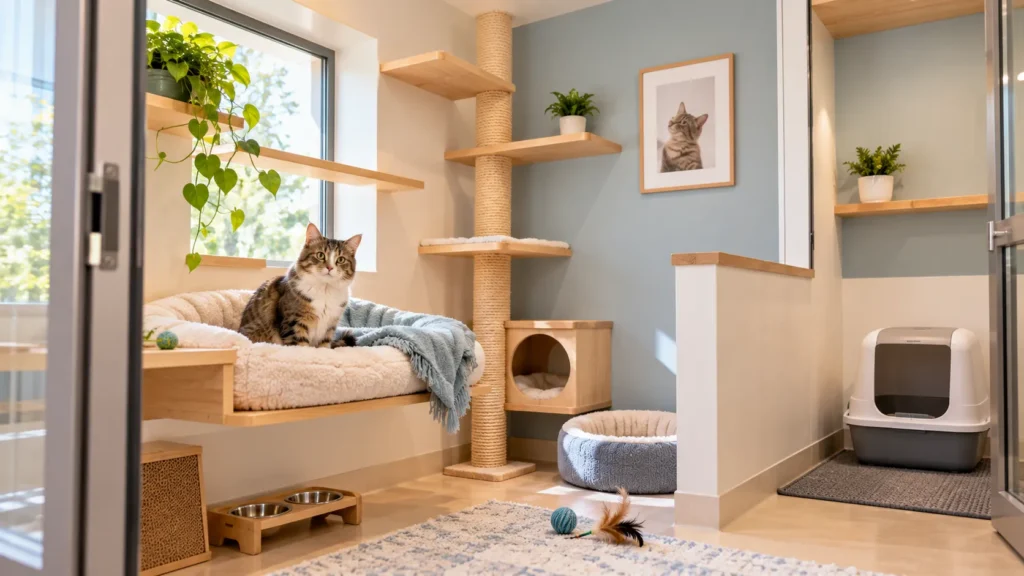
Good cat boarding houses only cats, gives each cat private space with the litter box away from food, and tracks eating daily. A cattery (a boarding business built only for cats) is far quieter than a boarding kennel that also takes dogs.
Why does that matter? Cats read barking as a threat they can’t escape. Picture sleeping in a hotel room beside an all-night party you can hear but never see. And if a place calls itself a cat hotel, ask what the suite actually includes.
In Illinois, the Animal Welfare Act requires kennel and cattery operators to be licensed by the Illinois Department of Agriculture. The law defines boarding as a stay longer than 12 hours or overnight. Ask any pet boarding business for its license, and for its vaccination requirements, before you book.
Before you book, check for:
- Vaccination requirements: proof of rabies and FVRCP, or titers or a vet exemption.
- Private space: room to climb and hide, not a single cage.
- Daily updates: photos or webcam access.
- Clear medication rules: what staff can give, and what needs a veterinarian.
- A tour: walk through it and trust your nose.
Boarding has limits too. We can’t give injections, since under the Illinois rules we operate by, injections by anyone but the owner count as veterinary service. For those cats, ask your veterinarian about medical boarding.
Flying out of O’Hare? Our guide to cat boarding near O’Hare covers what to ask at any facility, ours included.
Will your cat get separation anxiety while you’re away?
Some stress during a trip is normal, and most cats cope well when their care is steady.
Oregon State University researchers found in 2019 that about 64 percent of cats are securely attached to their owners, close to the rate seen in human infants, according to NBC News coverage of the Current Biology study.
That attachment is why routine and stress are so linked in feline behavior. A 2022 review in Frontiers in Veterinary Science describes stress showing first as behavior changes, then as appetite loss and overgrooming.
Separation anxiety in cats tends to stay mild when feeding times hold steady and familiar scent travels with them. Your scent works like a porch light left on, and caregivers who read feline behavior well notice early changes.
We cover the warning signs of separation anxiety in cats in signs your cat is stressed while you’re away. If the balance between routine and stress tips toward a full day without eating, call your veterinarian.
How do you prepare your cat before you travel?

Start travel planning for your cat two to four weeks before you leave, since holiday weeks book up first for sitters and pet boarding alike. Good travel planning makes the departure day calm.
- Book care early. Reserve as soon as your dates are set, then confirm the week before.
- Visit your veterinarian. Make sure vaccines are current and get records, since most boarding facilities ask for proof of rabies and FVRCP.
- Practice with the cat carrier. Leave it open in a favorite room for a week with treats inside, so it stops meaning “vet trip.”
- Write a one-page care sheet. Food amounts, medication times, hiding spots and your vet’s number.
- Pack familiar scent. A worn T-shirt or pillowcase goes with a boarded cat, or stays on a favorite chair at home.
- Keep the routine steady. Same food, same feeding times, same litter. A trip is a bad week to switch brands.
Where can you leave your cat when you travel from Chicago?

If you’re working out where to leave your cat when you travel from Chicago, weigh distance from home or the airport, then whether the facility takes dogs.
Meeow Chicago has boarded only cats since 2010, in Lincoln Park since 2013 and now near O’Hare too. Our story explains why we never added dogs.
- Meeow Chicago, Lincoln Park: 1765 North Elston Avenue, Suite 104, Chicago, IL 60642.
- Meeow Chicago, O’Hare: 4936 River Road, Schiller Park, IL 60176, about 2 miles from O’Hare International Airport.
- Phone or text: 773-917-7848.
For O’Hare travelers, covered valet airport parking sits about 75 feet from our door, and our team can collect your cat for $59 each way. See our Park and Fly options.
Frequently asked questions
How long can you leave a cat alone with an automatic feeder?
About 24 hours for a healthy adult cat. A feeder covers meals, not supervision: it can jam, run dry, or keep dispensing while your cat refuses food. For longer trips, pair it with a daily visit.
Do cats get sad when you go on vacation?
Many cats notice your absence. Expect some hiding, extra meowing or a smaller appetite for a day or two, then improvement. If your cat stops eating for a full day, your caregiver should call your veterinarian.
How much does cat boarding cost in Chicago?
Prices vary by suite size and season. As of October 2026, Meeow’s Classic Kitty Suite is $55 a day and the larger City Kitty Suite is $75, with peak-date rates of $75 and $95. A second cat sharing a suite adds $37 a day.
What vaccines does a cat need for boarding?
Most require rabies and FVRCP, the combination shot covering feline viral rhinotracheitis, calicivirus and panleukopenia (feline distemper). Some, including ours, accept a titer test or a veterinary exemption.
Can a cat sitter give medication?
Many professional sitters give pills, liquids or ear drops, usually for a per-visit fee. Ask before booking, not the night before.
What should you pack for a cat’s boarding stay?
Your cat’s usual food and litter, approved medications with written dosing, and one item that smells like home. Familiar food helps prevent stomach upset.
Bottom line: how to leave your cat when you travel, by trip length
| Trip or situation | Best option | Good backup |
|---|---|---|
| One night | Home with food, water, clean litter | One drop-in visit |
| 2 to 3 days | Drop-in cat sitter | A friend your cat knows |
| 4 to 7 days | Cats-only boarding facility | Twice-daily or overnight sitter |
| 8+ days | Cats-only boarding or live-in sitter | Never drop-ins alone |
| Daily oral medication | Boarding or an experienced sitter | Overnight sitter |
| Injectable medication | Medical boarding via your vet | Vet referral |
The best answer to what to do with your cat when traveling keeps your cat eating, observed and calm. Good vacation pet care starts with trip length, then temperament, then budget.
If boarding fits your trip, book a suite at Meeow Chicago, or get in touch with our team with questions first.
