
What You Need To Know (30-second read)
- Pet sitters win for short trips, cats that panic in a carrier, and cats that have never left home.
- Cats-only boarding wins for trips of four days or more, cats on daily medication, and multi-cat homes.
- In a classic boarding study of 140 cats, about two thirds settled well within two weeks, and most of the stress drop happened in the first four to five days.
- A drop-in sitter making two 30-minute visits leaves your cat alone about 23 hours a day.
- Seven days in our Classic Kitty Suite costs $385 at the standard rate, as of October 2026.
Cat boarding vs pet sitter is the question we hear most at our front desk, usually from someone sure boarding will traumatize their cat. Sometimes they’re right. Often they’re not.
A pet sitter keeps your cat in its own territory but alone most of the day. Cat boarding moves your cat to a new room with trained people nearby all day. The right pick depends on your cat’s temperament, health and trip length.
Cat boarding vs pet sitter: what’s the real difference?
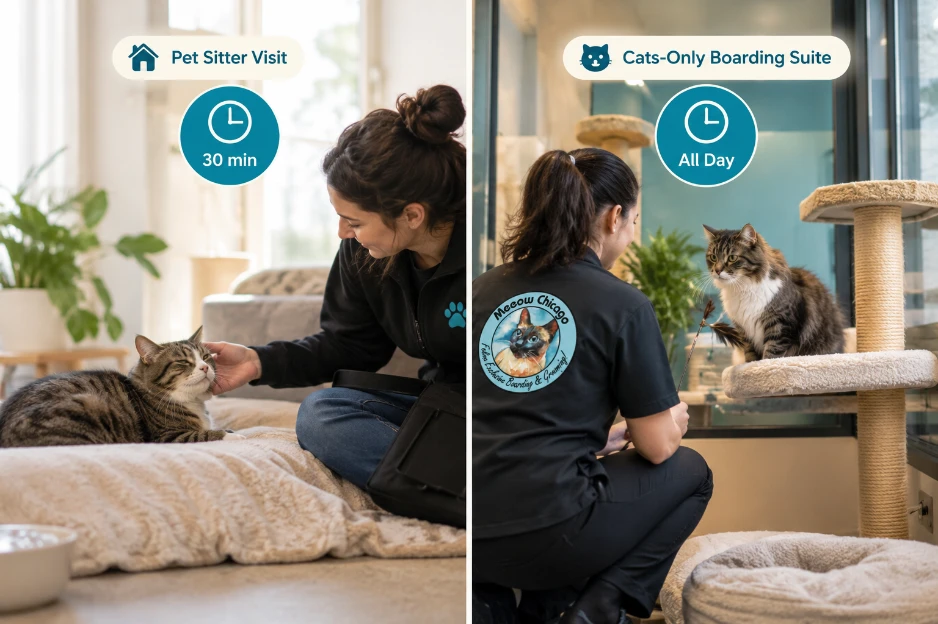
The real difference is coverage versus familiarity. A pet sitter is a paid caregiver who visits or stays in your home. Cat boarding is overnight care at a licensed facility, and a cattery is a boarding business built only for cats.
Think of it like a toddler choice: a babysitter at home, or a good daycare. One keeps the surroundings. The other keeps an adult in the room.
| Factor | Drop-in pet sitter | Overnight sitter | Cats-only boarding |
| Person nearby | 15 to 60 minutes a visit | Evenings and nights | All day, staffed 24/7 at Meeow |
| Home environment kept | Yes | Yes | No, but no dogs |
| Spots illness fast | Partly | Mostly | Yes |
| Medication administration | Add-on fee, varies | Add-on fee, varies | Oral and topical included |
| Best for | Trips under 3 days | Anxious seniors who hate cars | Longer trips, meds, multi-cat homes |
Is boarding stressful for cats? Here’s what the research says
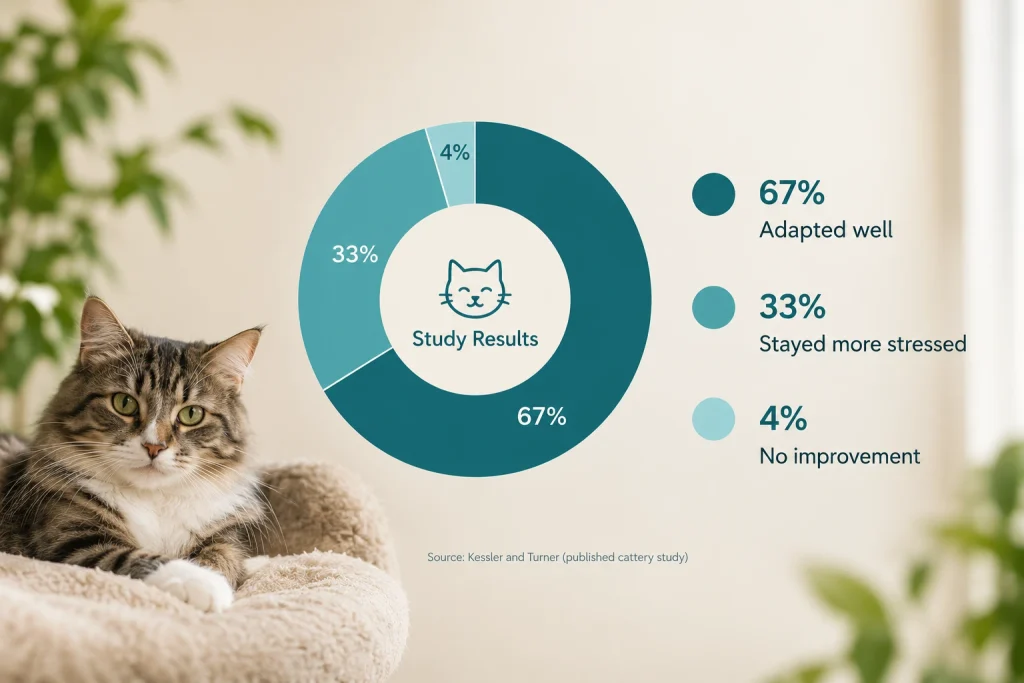
Boarding is stressful for some cats at first, and most adjust within days. In a study of 140 boarding cats in the journal Animal Welfare, Kessler and Turner found about two thirds adapted well over two weeks.
About one third stayed more stressed. For 4 percent, stress never dropped, so the authors judged boarding a poor fit for them.
A summary of the study design shows the sharpest improvement came between days one and five.
Space matters too. A follow-up study by the same team found cats in larger single enclosures showed lower stress in their first week than cats in smaller ones.
That’s why we built walk-in atrium suites with climbing walls instead of cages.
Why does feline stress happen at all? Cats show strong territorial behavior, and their home territory works like a security blanket. Pulling them off is a stressor even for confident cats.
Barking dogs make it worse, which is why a cat only facility matters. For the warning signs, see our guide to signs your cat is stressed while you’re away.
How does cat boarding cost compare with pet sitter cost for cats?
Cat boarding cost and pet sitter cost for cats land closer than most people expect. Pet Sitters International’s 2026 State of the Industry Survey put average US visits at $20 to $46 for 15 to 60 minutes.
GlobalPETS reported on October 5, 2026 that overnight stays averaged about $110. Most sitters offering overnights (62 percent) charge separately for a midday visit.
On the low end, Care.com listed Chicago cat sitters’ posted starting rates at about $18 an hour as of August 12, 2026.
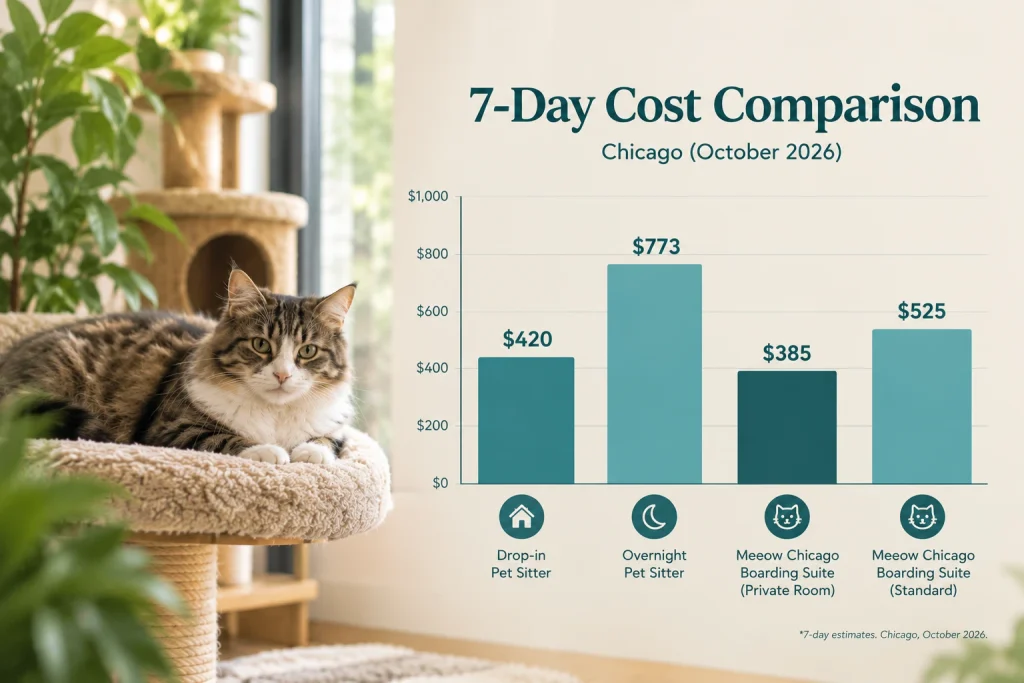
Here’s a seven-day cost comparison for one cat, as of October 2026:
| Option | How it’s priced | 7-day estimate |
| Drop-in sitter, 2 visits a day | Assumed $30 a visit | About $420 |
| Overnight sitter | About $110 a night (PSI average) | About $773 |
| Meeow Classic Kitty Suite | $55 a day standard | $385 |
| Meeow City Kitty Suite | $75 a day standard | $525 |
Two cats change the math. More than half of sitters charge for additional pets, per the PSI survey, while a second cat sharing a Meeow suite adds $37 a day.
Peak dates run higher ($75 Classic, $95 City Kitty), so check our current boarding rates before you book.
Ready to compare your dates? You can book Lincoln Park or O’Hare online any time, day or night.
When is an in-home cat sitter the better choice?
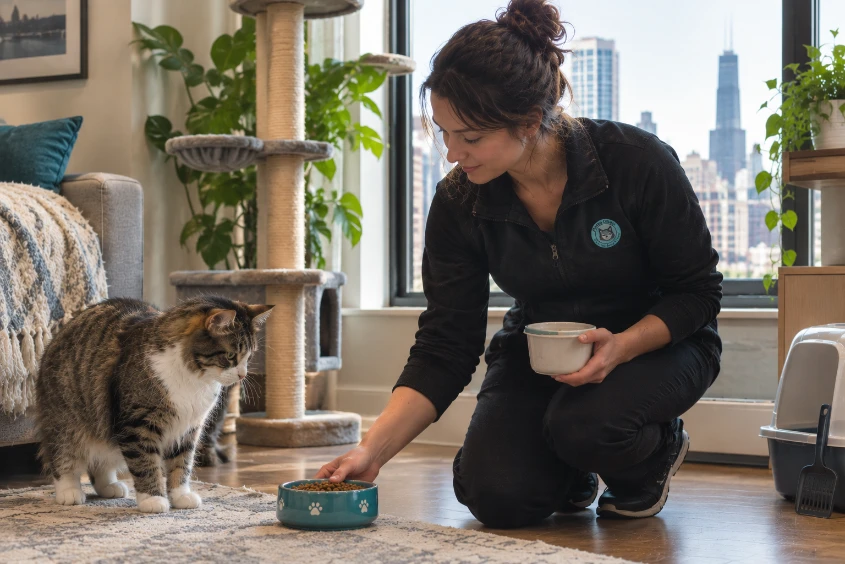
An in-home cat sitter is the better choice when the trip is short, the cat is healthy, and travel itself is the cat’s worst nightmare. We’ll be straight with you: we send some callers to sitters.
Choose a sitter if:
- Short trips: two or three nights, with two visits a day.
- Carrier panic: cats that drool, yowl or vomit in the car.
- Strong territory bond: cats that have never left home and hide for days after a vet visit.
- Pet sitter or boarding for cats with other pets: one sitter covering cats, a dog and fish can make sense.
Vet any sitter carefully. Marketplaces like Rover list both drop-in sitters and sitters who board cats at home. Ask about liability insurance or bonding, backup coverage, and a photo of your cat at every visit.
One Illinois detail: the Animal Welfare Act defines boarding as more than 12 hours or overnight, and cattery operators need a state license. If a sitter boards cats in their own home, ask about licensing.
Cat boarding pros and cons: when do cats only boarding facilities win?
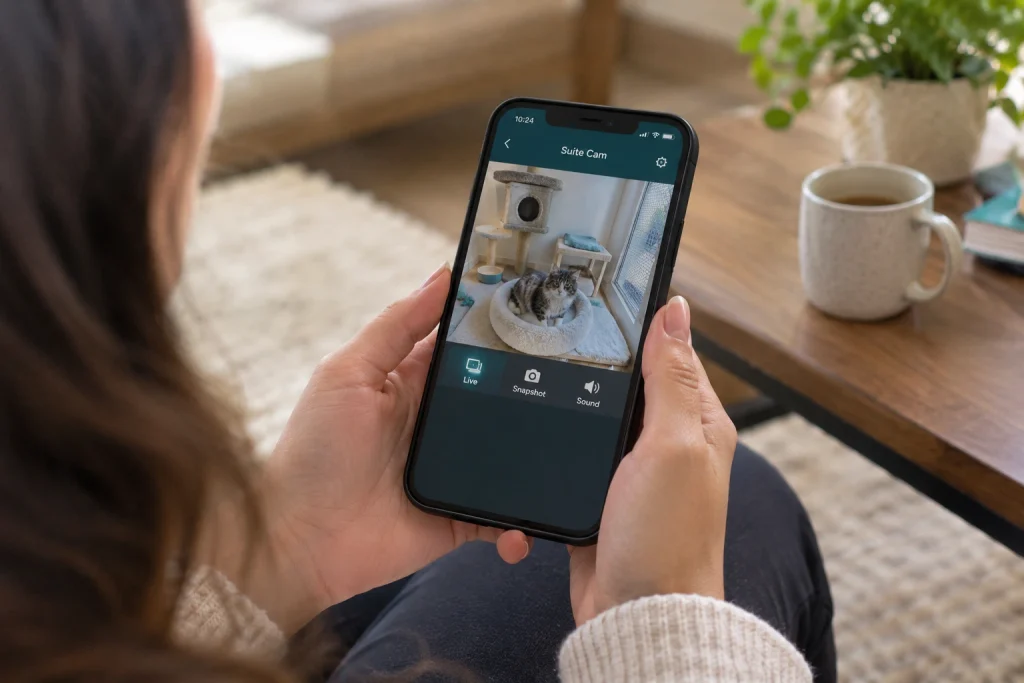
Cats only boarding wins when supervision matters more than familiar surroundings. That covers elderly cats on medication, diabetic or kidney cats, multi-cat households and any trip longer than four days.
The big pros:
- Medical emergencies get caught early: staff see each cat many times a day, so a skipped meal on day two gets noticed on day two.
- Medication administration: we give oral meds, pills in food and topical ointments at no extra charge.
- Webcam check-ins: our suite webcams run 8 AM to 8 PM Central, plus daily photo updates.
- No socialization pressure: good catteries don’t force cats to mingle. Your cat can hide, climb or nap.
The honest cons: a car ride, a new room, and an adjustment window. We also can’t give injections, since Illinois treats that as veterinary service unless the owner does it. Cats needing injections should go to medical boarding through a veterinarian.
Should I board my cat or get a sitter? Use this five-question scorecard
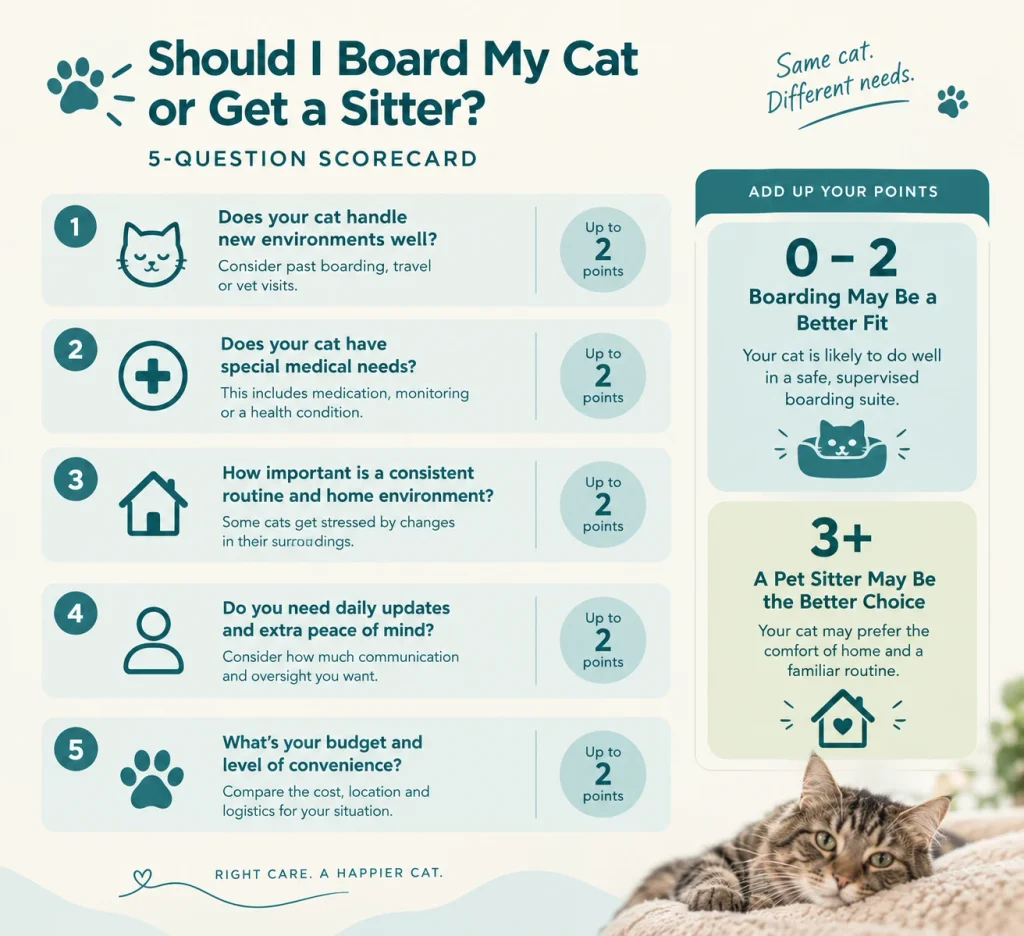
To decide, score each question, then add up the points. This works for most healthy adult cats.
- Trip length: under 4 days is 0 points. 4 days or longer is 2 points.
- Daily medication: none is 0. Oral or topical meds are 2.
- Number of cats: one cat is 0. Two or more is 1.
- Travel tolerance: rides calmly is 1. Panic in the carrier is 0.
- Eating when stressed: keeps eating is 0. Stop eating is 2.
A score of 0 to 2 points to an in-home cat sitter. A score of 3 or more points to a cats-only boarding facility.
Not sure how long your cat can safely go between visits? Read how long a cat can be left alone.
This scorecard is a starting point, not a diagnosis. If your cat has a serious health condition, ask your veterinarian first.
Frequently asked questions
Is a cat sitter vs cattery better for a shy cat?
It depends on how the shyness shows up. A shy cat that hides but keeps eating often does fine with an in home cat sitter. A shy cat that stops eating alone is riskier, since a sitter may never see it. In a quiet cattery with hiding spots, staff track every meal, so start with a short trial stay.
Is it better to board elderly cats or use a sitter?
Elderly cats on daily medication usually do better with boarding, because staff watch appetite, litter habits and hydration all day. Frail seniors may do better at home with an overnight sitter. International Cat Care notes infirm cats can struggle with ramps to raised beds, so ask about low-entry beds and litter boxes.
Does pet insurance cover cats while boarding or with a sitter?
Pet insurance covers eligible vet bills based on your policy, not on who’s caring for your cat, so check your policy’s terms. Leave your insurer’s name, policy number and your vet’s contact details in your care instructions so a sitter or boarding staff can act fast in an emergency.
Is pet sitter or boarding for cats better over the holidays?
Book early either way. Sitters fill up fast in December and often add a holiday surcharge, and boarding peak rates apply on busy dates. Flying out of O’Hare? Our Park and Fly options let you drop your cat and walk to covered airport parking 75 feet from our door.
Can you watch your cat on a webcam while boarding?
Yes, at many modern catteries. At Meeow Chicago, suite webcams run daily from 8 AM to 8 PM Central, plus daily photo updates by text. One client wrote that an upgraded suite let them play with their cats using a remote laser pointer. With a drop-in sitter, you’d need your own home camera.
Bottom line: which is better for your cat?
Neither option is universally better. A pet sitter protects your cat’s territory, while cat boarding protects its supervision. Match the choice to the cat, not to your guilt.
For short trips with a calm, healthy cat, hire a trusted sitter. For longer trips, meds or multiple cats, choose a cats-only facility with real space and staff on site. That’s been our approach to Chicago pet care since 2010.
Want the bigger picture on every travel option? Read how to leave your cat when you travel, or meet the team behind Meeow Chicago.
Questions about your cat? Text us at 773-917-7848 and we’ll help you decide.
